
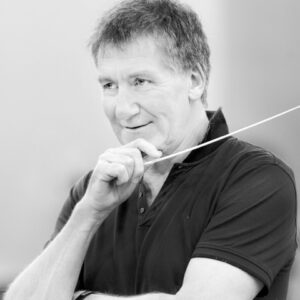
George Fenton was born George Richard Ian Howe in Bromley, Kent in 1949, one of five siblings. Although not musicians, both parents were musical, and his paternal great-grandather was a conductor who had been a chorister as a child. George sang in church choirs as a boy, but it was the electric guitar – a Rosetti Lucky 7 – that first won his heart at the age of 7.
When he was 12, George began to study the church organ and was fortunate to encounter two exceptionally gifted musicians who would have a lasting influence on him. Both were former cathedral organists who worked at St Edward’s School in Oxford: director of music David Pettit, who went on to have an outstanding career as a performer and an academic, and assistant director Peter Whitehouse, who George credits with being the most important person in his musical life, both as a teacher and, ultimately, as a colleague. Whitehouse continued to mentor and work with George until his death in 1992.
After passing on the opportunity to go to music college, George played in various bands and did a string of odd jobs until 1968, when he was cast in Alan Bennett’s play, Forty Years On, and also understudied the show’s musical director, Carl Davis (who himself became a prominent film and television composer). In order to appear onstage in the show, George had to join Equity, and as the rules prohibited two people having the same name and there already was a George Howe in the union, George adopted his mother’s maiden name and became George Fenton.
While George was still in Forty Years On, he signed a record contract at MCA as a recording artist, and then one with his band at Decca. He worked as a session musician for some pop artists, and did some arranging for Carl Davis and others in theatre and television. During this time, he became increasingly interested in Middle- and Far Eastern music thanks to meeting, studying, and working with the remarkable musician and ethnomusicologist John Leach.
In 1974, director Peter Gill asked George to write the music for Twelfth Night for the RSC in Stratford. Since then, George has written extensively for theatre, television, and film. He was one of the original group that founded the Association of Professional Composers in 1976, which later amalgamated with two other organisations to become the British Academy of Composers & Songwriters. His theatre composition work spans all of Peter Gill’s productions at Riverside Studios to Alan Bennett’s Hymn and Cocktail Sticks at the National Theatre. He also wrote the musical Mrs Henderson Presents, which was produced in the West End in 2016, and the music for the BBC’s 2020 Talking Heads, both for television and at London’s Bridge Theatre. This was followed swiftly by ‘Beat The Devil’ with Ralph Fiennes, ‘Bach & Sons’ and ‘Straight Line Crazy’, also at The Bridge.
Whilst working in theatre, George began to write scores for television. His score for Stephen Poliakoff’s Hitting Town was the first of many TV adaptations he worked on. Throughout the ‘80s, he wrote the music for a variety of series, including the BAFTA-winning The Jewel in the Crown; The Monocled Mutineer, and Alan Bennett’s Talking Heads. He has also written many well-known themes for television, including BBC’s One O’Clock News; Six O’Clock News; Nine O’Clock News; Newsnight; The Money Programme; and the hit series Bergerac (another BAFTA winner).
In 1990, George scored his first natural history documentary series, David Attenborough’s The Trials of Life; this was followed by Attenborough’s next series, Life in the Freezer, which led to producer Alastair Fothergill asking George to compose the music for The Blue Planet in 2001 and beginning a 10-year period of writing for natural history television programmes, including Planet Earth; Frozen Planet; and Life. In 2022 George partnered again with Alastair Fothergill and David Attenborough, this time for BBC One’s Wild Isles series. George also went on to turn The Blue Planet score into the influential concert series, The Blue Planet Live!, in which an orchestra played live to sections of the cinematic footage. In 2003, he scored and conducted the music for the documentary film Deep Blue, which was performed by the Berlin Philharmonic Orchestra – the first film score the Orchestra had recorded in its history. In 2007, they repeated the collaboration for the documentary film, Earth. Together with producer Jane Carter, George turned each of the scores into concert works, and his live film scores continue to be performed by orchestras worldwide.
As an indirect result of studying with John Leach, and a direct result of his work at Riverside Studios, Richard Attenborough asked George to co-write the score to the 1982 bopic Gandhi with Ravi Shankar, which score was nominated for an Academy Award. George went on to score four more of Attenborough’s films, including Cry Freedom and Shadowlands. In fact, many of the films he has scored have been the result of long-lasting relationships with directors such as Stephen Frears, Nora Ephron, and Ken Loach. Some collaborations are particularly prolific: He has written scores for a total of 18 features directed by Loach, including Sorry We Missed You and The Old Oak. Other film scores include Andy Tennant’s The Secret: Dare To Dream and Unit 234; The United Way; Beat The Devil; The Duke; Dangerous Liaisons; You’ve Got Mail; The Fisher King; Ever After: A Cinderella Story; The Madness of King George; Sweet Home Alabama; Hitch; Memphis Belle; The Lady In The Van; Groundhog Day; and many, many more.
George began to be recognized for his scoring work in the 1980s, and received his first award at the BAFTAs in 1982 for ‘Best Original TV Music’ with Bergerac and The History Man. To date, George has received a total of 21 BAFTA nominations with three wins; five Academy Award nominations, three Emmy Award nominations (two wins), sixteen Ivor Novello nominations (five wins); and three Golden Globe nominations, among many other nominations and awards. He won a Classic Brit Award in 2007; and was honored with a World Soundtrack Award Lifetime Achievement award in 2015.
George Fenton passed away unexpectedly on October 5, 2026 in London, at the age of 76. He was a BASCA Fellow –one of just 18 songwriters and composers to have been bestowed this huge honour— a member of the Academy of Motion Picture Arts and Sciences, and a visiting professor at the Royal College of Music and the University of Nottingham. In 2023, he was was appointed Commander of the Order of the British Empire (CBE) for services to music.